Giada Matteini
I wanted to chat about your motivations for coming up with the exhibition, and where you came in with it. Maybe you can introduce what it is and then we can go a bit deeper about the data itself.
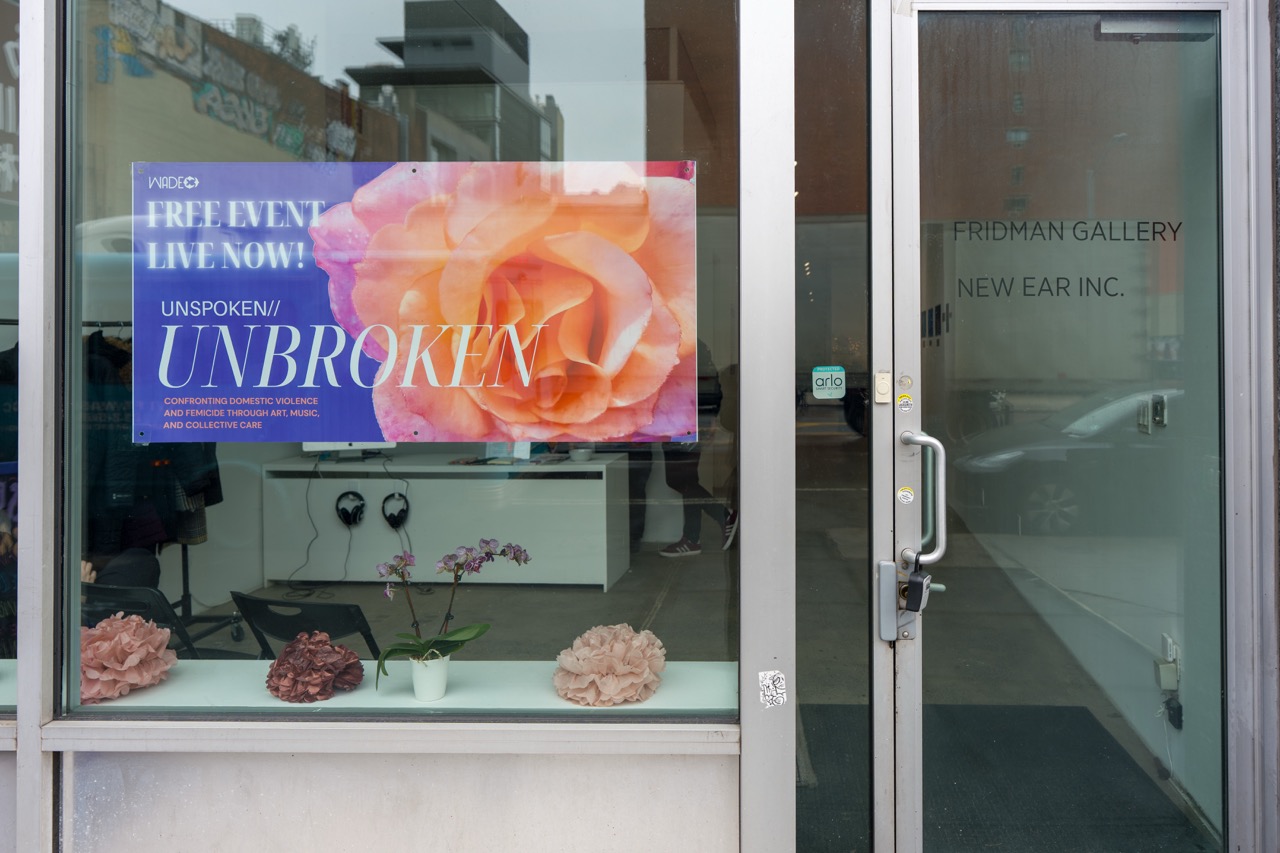
So the project is called unspoken//unbrokenunspoken//unbroken. is an exhibition by WADE looking at domestic violence and femicide through performance, visual art, and data., and it came out of this idea of looking at domestic violence and what is unseen. What stories are told, what’s not told. I wanted to incorporate visual art and visual storytelling with performing arts. That’s what I do, right? I’m a performing artist, I’m a dancer, I teach dance. I curate dance.
But I wanted something that had different points of entry. To be more legible for a wider audience. So that’s when the idea of an exhibition came, where there’s different things happening at the same time. They’re still performing arts because that’s, you know, at my heart, and I think it’s very strong. But there’s all these other elements that happen.
And then people can travel through them at their own pace, without having to sit in a theater and wait for someone to explain or show things. So that’s the basic idea of when it started.
And why the topic of femicide?
So my research is around domestic violence in general. I have been looking at this for many, many years from many different spaces. I’m also Italian, right? So I have this experience of what’s happening in Italy versus what’s happening here.
During my research, it came about that femicide. We celebrate women’s lives on November 25th, right? There’s this International Day Against Domestic ViolenceInternational Day for the Elimination of Violence against Women. Observed annually on November 25 by the United Nations.. And on that day we celebrate women who are not here anymore. Women who actually lost that fight. So I started to look into it, and it became really fascinating to me how differently this subject is taken by different governments.
In Italy, strangely enough (I’m not saying that Italians are much more intellectually advanced), they have a way of tracking women killed by partners. And in South America they have that too. If you are someone who kills a woman because of their gender, they consider it a hate crime. Like you would kill an LGBTQ person, or a person of a different ethnicity than you.
The United States doesn’t do that. The United States doesn’t have that distinction. I was reading about this stuff in Italy. I wanted to find out what was happening in the US, and I realized that’s not a thing in the US. There is no distinction between one homicide or the other.
So I became fascinated by the idea of why this wasn’t a thing. I was trying to find data, and there is no data. And then I found, you know, that’s how you and I came to make this project together. I came across this article by these incredible women researchers who researched a specific thing. I spoke to them.
They said, yeah, there’s no research. There’s no data. The data doesn’t exist, because it is not tracked as a hate crime. We don’t really know how many women are being affected this way.
I was just fascinated by this idea of not even knowing exactly how many women have been lost to it. It’s a homicide. But of course that also comes with the idea that we don’t really have specific data about domestic violence either. We have a lot of data, but it’s not super clear, because a lot of women, or men (domestic violence affects everybody), don’t even bring it to the forefront.
So even the data on domestic violence is not completely reliable, but it is there. There are big organizations all over the world, all over the United States, that take care of those data sets, so you get them from different spaces. But not in femicide.
So I thought there’s a gap in the way it’s tracked. I was interested in pursuing it.
Talking about the data itself, what we found out is there’s just one person collecting all of it, meticulously going through newspapers and articles and documents to record a very thorough data set. There’s names, the names of the people involved, details about each woman. It’s very thorough. So I’m curious to know if the story of the person collecting it influenced any parts of how you thought about showing the data itself.
Well, I find this work that sheDawn Wilcox runs Women Count USA, a database that tracks women and girls killed by men in the United States, compiled largely from news reports and obituaries. is doing on Wilcox. I found out through these other women that are doing this research that she’s originally a nurse. That’s pretty much what I know. She’s a nurse who, I’m assuming, is impacted somehow by this and realized that there was a gap. She started doing it.
To me, it’s very important to recognize people who do this kind of work out of their own time. And I’m sure it’s not easy. To collect this very emotional data and to be mindful about what you share. It’s very complicated. So I have a lot of respect for her. I briefly spoke to her about our project to make sure it was okay.
It really resonated with me, what she’s doing with what I want to do. That I want to give voices to women who don’t have a voice, or men who don’t have a voice, whoever is being affected. And that’s what she’s doing. It’s only one person, so I’m assuming that the data cannot be complete. That’s why you and I had this conversation about being completely transparent, that this is one woman.
One person. The data doesn’t come from incredibly funded spaces. It comes from one woman who does this part-time in her house. So we’re transparent. This is the data that we have. It’s not complete. There’s missing information. But it’s very powerful to me.
The actual act of doing that. For her to do that. It’s an act of solidarity, and it’s an act of courage, and it’s an act of one person showing that progress can be made even by one person. She’s finding something that is not here, and she’s creating it, and she’s continuing to add on to the stories.
Even in the exhibit, I found myself telling people who were looking at it about who was collecting it. Just telling that story as well, because it felt important to include that in the piece itself.
I agree. It’s important because it’s something that is relevant to another human being. That she’s spending this time telling stories of others. I can’t imagine. Every time I spend time with that data, I get very emotional. Any time that I try to read the stories and want to know about them, I get really emotional, and I get upset.
There’s definitely a visual response to it. So for her to be so courageous and maintain this process, it cannot be easy through the years. She’s been doing it for many years. So yeah, I also like to tell this story of hers. This is what this woman does. She’s already taking care of people by being a nurse, and she’s doing this extra work.
What you mentioned earlier about the emotion aspect of it. I remember you telling me when I sent you the website and you were going through it, it did elicit an emotional response. I felt the same way. Going through all of these human stories, actual people who existed and now no more. Just like information and stories, other people talking about their obituaries. I think that’s what gave that emotional response to the piece itself. Which is why I’m curious. While developing the piece, because we did this in two parts, one last year and an updated version this year. Between that, one of the major feedbacks you had was to include these stories in the piece. Why do you think that is? Why do you think including just that element of a person’s story changes it so much?
You said it kind of already. When you see numbers, they’re just numbers. I can continue saying, two in three women, or three in five men, have been affected by domestic violence. But they’re just numbers.
When you see the stories, you go, my god, this is a person. They had a family, they had dreams. They were either very young and beginning their life, or had grandchildren. It doesn’t matter where they are in life. There’s a heaviness of recognizing that that’s a person. And so that’s why I think it’s important.
That’s another way, and this is what attracted me to this kind of data, because I don’t know how to do it. This ability to be both beautiful, because your project is beautiful. To see, to be interactive. You can feel like you’re part of it. And then it’s educational, and then it’s also human. So to me, this idea that data is not dry. Data comes from people in this case. That’s what was really important to me.
By opening up these flowers and reading even just the smallest thing about them. Because again, she’s only getting this stuff from newspapers, from Facebook posts, whatever. It gives you a glimpse, and it opens up to the whole universe that’s their lives. And the people they have in their lives. The friends, the family, the children. That’s also an extra layer. You realize how impactful this loss is. Not just for that person, but for those around her.
So that’s why I wanted to include the actual stories. And I’m working on part three. That’s not a conversation we’re going to do, but part three also involves success stories. This is what’s missing. We’ve been concentrating on educating, bringing some things to light, and showing this data.
But there’s so many success stories that are also not told, or are told and we don’t pay attention. We only pay attention to these dramatic things. But what about all the women and men who actually have survived and thrived and created? So that’s the next part. By humanizing them. By not making them ‘I’m a survivor of domestic violence.’ I am a lot more than that.
This idea of humanizing people who are affected by domestic violence. Those who don’t make it, unfortunately. To bring more awareness, to change policies, to have an educational space where people can learn how to have conversations. How to push for policy change. Which is not up to us, because we’re artists, we can’t do that. But we can push for it if we bring enough attention to it.
And then this other side of honoring those who are making the effort. All those workers who, every day, are there to support the survivors. One thing we also did in this last exhibition: we had information on all these organizations. Most are New York based, but some were national. Where you can get help, where you can get support. When I speak to these organizations, that is the one thing they really want out there.
How do you reach us? Do you know we exist? Like, we’re here. Women, men, young people that need help. To try to get this information out there as much as possible, so that they know they are not alone. Because I know that when I was going through this, I didn’t know who to talk to. It was a different time obviously. It was not so technology-heavy.
So it wants to be a space for many different things, around the same topic, that comes from whatever my research is going.
Talking about your research. You do a lot of performance-based work, and even this exhibit involved a performative element. The piece, the flowers on the wall. Every 10 minutes, I think it is, the person gets up and takes a flower off the wall. You see some information behind it. The names, things like that. How do you think the context of the piece, it being performative, what does that add to someone looking at it from the outside?
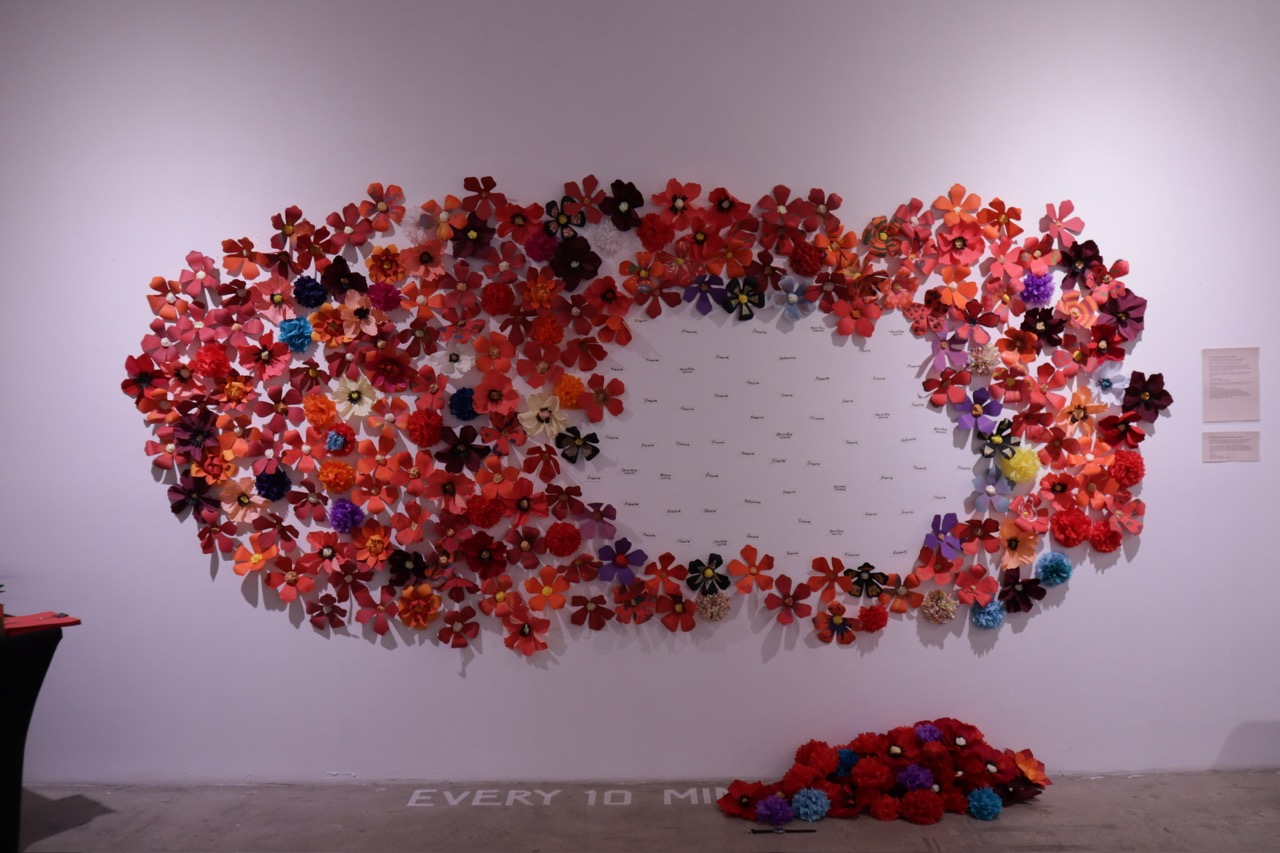
I think it adds immediacy, and it makes it real. That piece was born out of the general global data we have. Because again, we don’t have it in the United States. So the global average of women killed by a partner or family member is one every ten minutes. That’s the UN estimated idea.
If you actually sit there and think about it: one every ten minutes. How many people is that? So the idea is, okay, we’re here in this gallery from 11AM to 8PM. By getting up every 10 minutes and taking these flowers and putting them on the ground, you see the accumulation. It’s blatant that, my God, we just lost this amount of women, or men, or young people, while we’re here in the gallery, or while we’re at work.
So the idea was to be present for these moments. Which is kind of hard for those women and people who are taking the flower out. But also to honor it, and to recognize the passage of time and how consistent it is.
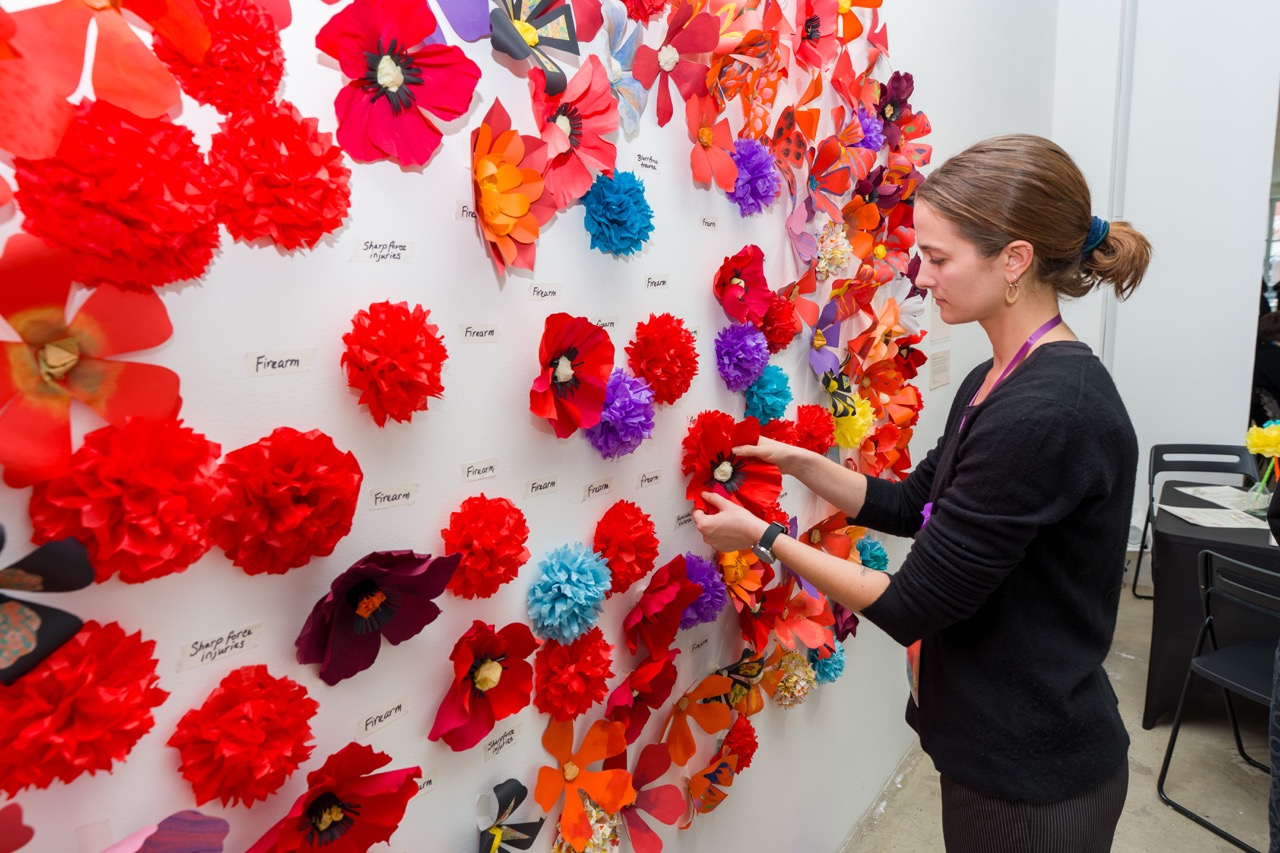
And what I did, because again our data is limited. Under the flowers, I put the mode of death. How were these women killed, which I took from Dawn. Because I wanted to bring to light that gun control and femicide have a very deep connection in the US. Most of those labels were guns. There are other modes, but that was the main one.
They’re intertwined. These issues do not live on their own. So if we figure out a way to maybe control gun availability, it might solve some of these issues. That’s what I wanted to bring.
It’s a way of witnessing, of open memory. To get an almost gut sensation out of, okay, I’ve been here for two hours, and eight women have gone. And that realization. To understand that it’s an ongoing problem.
You think about a statistic, one person every 10 minutes, and you read it in a paper or a report and you just pass by it. But like you said, giving time for someone to experience what that really means. While I was there as well, I could see the wall getting more bare, the flowers coming down over time. You get the impact of it by being present in it.
Exactly. You touched on something that’s very important and actually inspired this whole idea: if I read it, it’s one thing. If I see it, it’s another. If I read it is one thing, if I feel it is another. This is why I do believe that the arts are powerful. They make you feel it. The numbers are not going to make you feel it unless they’re used in a certain way.
Domestic violence is one of those things that’s, I’m not saying normalized, but in a way it is normalized. We kind of take it. A woman is killed. The first question that’s asked: did the husband kill her, or did the boyfriend kill her? That’s the first question. If you think about it, that’s not a good thing.
The other thing I noticed: no one is pro domestic violence. Who do you know that goes around saying domestic violence is good? Nobody. You have people that say I’m pro guns. You have people that say I don’t care, I can smoke whenever I want. But nobody says I’m for domestic violence. Yet here we are.
These numbers are so staggering and so scary that even the best intentioned people don’t want to relate to it. They’re too hard to digest.
And it’s also the normalization of it. Speaking with all these amazing pioneers around domestic violence, the biggest win we’ve had in the last 20 years is that domestic violence is finally recognized as a crime. That wasn’t even the case 20 years ago. So it’s very slow progressing. We need more visual data, more data that makes you feel something.
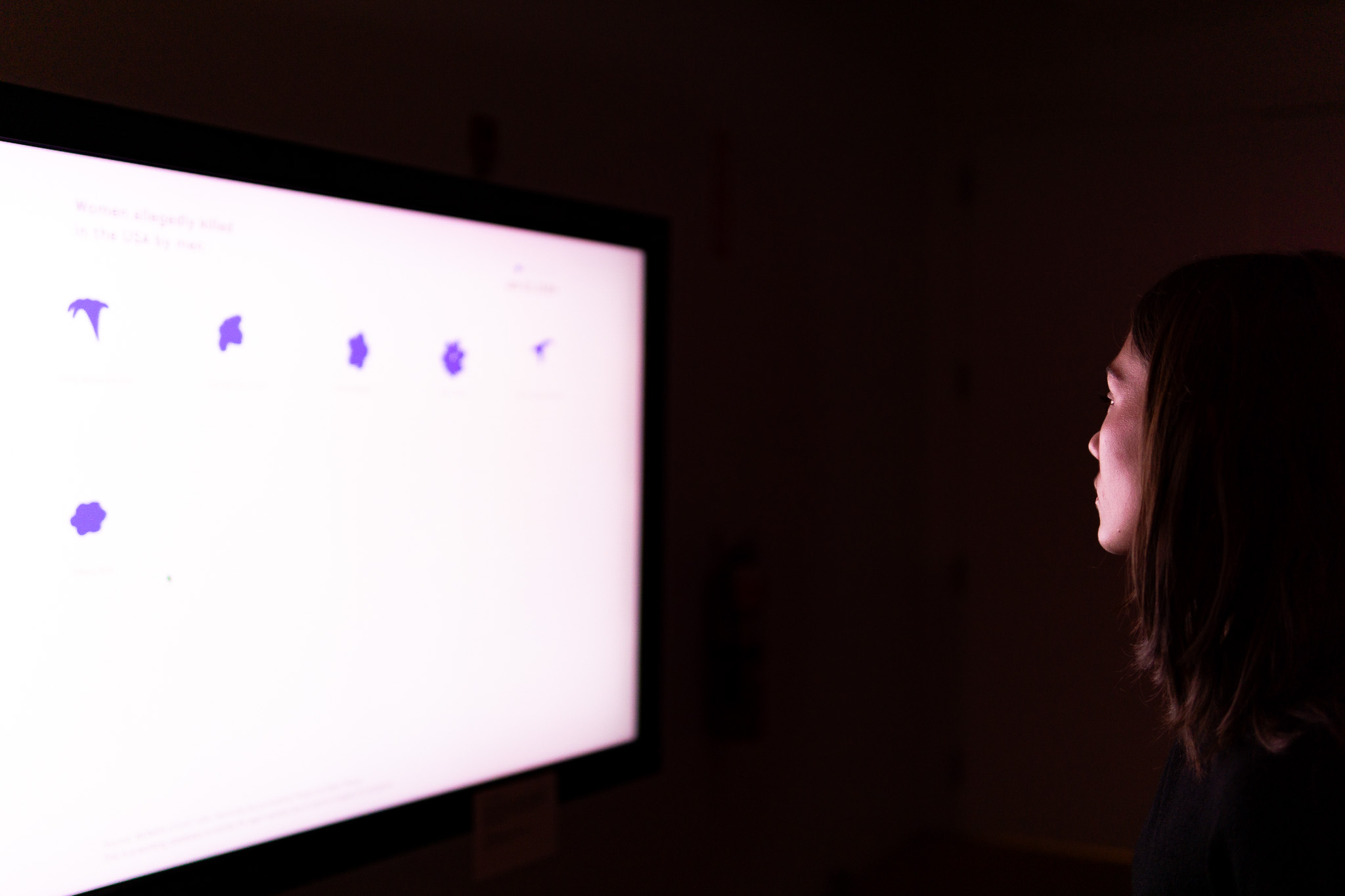
Even the digital piece I helped with. Even though it’s digital, just a website. The fact that the context it was in was a physical space, where there were other people engaging with it, that forces you to talk to other people and get to know more about it. There’s something about the context of it being showcased that way. I know we were talking about the piece living on WADE’s website, the webpage visualization. But there’s a difference between that and exhibiting it. So I’m curious what your thoughts are about that.
I agree. There’s that community-based thing that’s important. And of course, having you explain what it is, so they have this idea that it’s been created by a human and not by AI. And that there’s all this research behind it. But also, you play with it. You move around with it, with someone else, and you start a conversation. It’s a very beautiful thing.
In the context of where you are, it’s about community. It’s about conversations. I want to have it on my website, because I want it to be accessible. This is the other thing I really want to push the company forward with: accessibility. This last gallery we did was free. Everything was free. The performances were free, the wine was free.
Because when I do a lot of productions in performance, I have to rent a theater. It’s a different kind of expense. You can still do it free. But there’s something about having accessibility to this kind of research. That’s the reason why I want to have it on the website, so that people can see it in their own home, wherever they are, and it can reach a wider audience.
But I have all the intentions in the world to continue presenting this kind of work in a gallery setting, alongside whatever else is happening. Because it is powerful. It’s another way to enter the conversation.
This is the thing I’ve been struggling with as a performing artist. I understand why the work I present, talking about domestic violence. I curated. I’m engaging artists who are researching a topic around domestic violence, or use certain music. But it can be very abstract. It needs some kind of explanation for people to see, unless it’s blatantly using words. It has a very visceral and beautiful effect on people. That’s one way of doing it.
But I couldn’t just do that anymore. To me, it’s not enough. This is why you come in. You have this way of doing art and data and accessibility and research that’s aligned to what I’m doing. But some other people may react and respond to your work, and to the way you present it, more clearly than to mine.
I think that’s exciting for my own artistic projection. I’m really opening up to different ways of doing what I love. We had this wonderful singer who curated the whole entire set. A two-hour set. Amazing. She curated it around the topics of the exhibition. That’s easier, because you hear it. There are words. There’s music. You have a different reaction, but it’s more immediate.
Every ten minutes, I thought it was very immediate, because you’re right there. You see it. But then with other works you have to reflect on your own. We had workshops where we were making flowers and adding them on. That’s another way of being part of the event. We had a couple of workshops, physical workshops, live music workshops.
I’m just trying to figure out ways to keep people engaged, and meet them where they feel most. Because at the end of the day, this is a space of community, of storytelling, of truth-telling. But it’s also a place of joy. It’s not specifically a place where we just want to come and be depressed. We want to acknowledge the data, we want to have conversations and come up with ideas. But then we want to move, we want to dance, we want to be in community.
That’s what I’m playing with. I’m trying to make that legible, so that people don’t go, ‘my god, another thing about domestic violence, I can’t. I’m too depressed.’
When you mentioned meeting people where they are. There are these two ends of the spectrum. One is completely performance. You have to be there present physically to experience it. The other end is raw statistics and graphs. Maybe you’re on a subway and you scroll through it on your phone. You can’t really expect someone who’s in a subway to be present in a performance. And the other way also holds true. So that’s a really nice way of seeing: meeting people where they are, and having different ways of reaching them based on how they can access the information.
That’s what I mean. I’m not trying to meet anyone’s level of anything. I just ask: what do you want? What is the best way for you to receive this information? I know people who don’t like going to museums, and I know people who love going to museums. Performances, non-performances. I feel that it’s exciting to figure out how to have a varied community of people. Different ages, different backgrounds, coming together and talking about something that’s affecting them.
I had this group of very adorable senior citizens who came from Harlem, and we had a great time. We had a workshop, arts and music and dance. But then we spoke about the topics. They were interested. They were relating them to where their lives were. But maybe for them it wasn’t the same approach as the younger kids who come for happy hour, who have a different idea of where they are in life.
I’m very excited to figure out, alongside the community that grows, what people want to hear, want to see. How do we create this space that’s really accessible to everybody?
That’s amazing. I think that’s a good place to end this conversation. Thank you so much, Giada, for agreeing to do this in the first place.